Showing posts with label safety. Show all posts

Wednesday, July 27, 2011

Wearing a Walker

When first home with a newborn, wearing your child might be the way you manage to see to their need to be held while also making sure you have clean clothes and dishes.  But as your child ages, you may find you do less wearing in the house, and much of your wearing becomes about your convenience or saving your toddler from himself.

This past weekend, my family attended a family reunion.  One of the relatives commented that this was the first year in a long time she could remember me not having a child in "a papoose."  It's true, my 3yr old was very needy and she was worn for 2 reunions in a row, then my youngest was a baby last year.  But this year she is an outgoing 19mo old and she was off to play with her cousins.  But when evening came, we were going to make s'mores on the beach.  An adventurous walker and fire really don't mix, so I put her on my back.  She got to be part of the s'mores fun, she got to taste a little roasted marshmallow, but I didn't have to worry that when I was distracted by an older child she would find herself falling face first into an open fire.

Travel is another time that wearing a walker can be a help to you and them.  Airports, train and subway stations are all very crowded, there are people pulling carts right at toddler level, often there are employees zipping around on golf carts, it is a disaster in the making with a toddler on the loose.  You usually have your hands full with your carry-on bag full of activities for the trip, and probably a carseat as well, so holding hands isn't practical.  Cynthia found wearing her toddler made the trip easier for her and gave her toddler a better vantage point for her adventure than the legs and rolling suitcases that are at her height.

When you are near water or on a long walk can be another time when wearing a toddler may be the best choice.  We went for a walk near a local lake.  My toddler LOVES water.  She has no fear of it and will happily march into any body of water from pool to lake to ocean.  I am often saving her from herself.  Since we intended to go playing after our walk, a wet toddler wasn't on the agenda.  So, I put her on my back while we enjoyed our walk (and we weren't forced to amble at 19mo old pace), the kids got to look for fish in the water and I didn't have to be concerned about an impromptu dip.  Wearing can also be a great way to keep your dolls safe from falls.

A final time you may find yourself wearing a walker might be when they get very tired at the end of a long day, or if they manage to injure themselves, or like our recent adventure, they leave their shoes at home.  I took my kids to see a show at Wolf Trap's Theatre in the Woods.  These are special shows for kids, and they are a lot of fun.  When we parked my 3yr old announced that she had no shoes.  I hadn't noticed when we were leaving the house (A similar thing happened when my oldest was 4 and got blisters from her shoes when we were starting a day downtown).  I put my 3 and 1yr olds on and proceeded to walk into the theatre.  Now, if you've been to Wolf Trap, you know the children's theatre is up a big hill and then down an even bigger one.  By the time we got to the top of the first hill, I remembered that I haven't been keeping up with my exercise.  Hauling an extra 70lbs up that hill was really a challenge.  I don't recommend it be the plan when you start out on your adventure, but in a pinch, it can be done.

Wearing a walker is about making them safe and comfortable and about making your trip run as smoothly as possible.  Yes, they CAN walk, but not every situation is ideal to allow them to walk.  Enjoy those toddler snuggles, all too soon they'll insist on being on their own two feet!

Friday, April 8, 2011

Safety Notice: Back Wrapping NOT for stretchy wraps

This video shares what could happen when back wrapping with a stretchy wrap. Please use only woven wraps for back carries. If you are not able to afford a commercial woven, a crinkle cotton gauze or a table cloth can be made into a wrap very easily if you DIY.


The safety of your baby is the most important thing to remember when selecting a carrier.


*This video is not made by BWI, thank you to the maker of this video for sharing the reasons to avoid stretchies for back wrapping.

Thursday, October 7, 2010

IBW - Day 2: Helping Mamas to Wear Their Babies Safely!

Today, Babywearing International of DC-MD-VA hosted a carrier safety check at At Play Cafe in Reston, VA.  A few mamas came for the check, but most of the mamas we helped were there for their children to play and they jumped in to ask for help when they saw us there.  We also staged an intervention on one poor mama who somehow had managed to get her ring sling on backwards.

Anyway, we'll let the pictures speak for the happy mamas and babies.


Thanks for coming out mamas!  We had a great time!  We hope to see you all on Saturday at the Family Babywearing Walk!

Monday, October 4, 2010

Come to Our Carrier Safety Check!

As part of our plans to celebrate International Babywearing Week, Babywearing International of DC-MD-VA is hosting a carrier safety check at At Play Cafe in Reston, VA.  This check will take place Thursday, October 7th from 10am to Noon.  At the check, volunteers will check your carrier for safe construction and will help you to ensure that your baby is in the best possible position when worn in your carrier.  This event is free; however, you may choose to allow your toddler to play in the supervised play area for a fee.

Wednesday, March 24, 2010

Infantino Slingrider Recalled

A couple of weeks ago we posted about the CPSC warning on slings.  In that post we discussed the dangers of "bag style" slings like the Infantino Slingrider.  At the time, Infantino continued to maintain that the Slingrider was safe despite the research and evidence of deaths attributed to positional asphyxia in the Slingrider in particular.  We are happy to report that today the CPSC has issued a recall of the Slingrider and the Infantino made Wendy Bellisimo bag sling.  We hope this will encourage other makers of similar style baby duffles to remove them from the market.  

Any carrier that places a newborn or infant in an unnatural position for carrying in arms is not a safe choice.  Any carrier that forces baby to have her chin to her chest is unsafe.  If you are unsure if your carrier is safe, please seek help from a babywearing educator.


If you are looking for safe, comfortable choices for wearing your infant or toddler, attend a Babywearing International of DC/MD/VA meeting, skilled babywearers will be able to help you try carriers and learn safe positioning.  We look forward to helping you become a safe babywearer.

Monday, March 15, 2010

Just what does one DO at a Babywearing Meeting?

This is a question I hear often.  How do you meet about babywearing?  Well, let me give you an overview of what you might do at a meeting:

1. Learn about carrier types
Confused about what type of carrier would work best for you?  Not sure what makes a pouch or ring sling different from a mei tai or soft structured carrier.  Confused how wraps work?  Wonder which style will be best for spring hikes, or which will look nice at your cousin's June wedding?  We have examples and can help you choose a style that works with your needs.  You can also make use of our extensive library to try carriers and determine which one  (or two, or three, or ten - okay, some of MAY have a FEW too many carriers, but don't tell our husbands) is right for you.

2. Learn how to wear a newborn, infant, or toddler safely and comfortably
Babywearing is a skill, and like all skills, it requires instruction and practice.  Since it is a skill involving your baby, it really isn't one that should be left up to trial and error.  While pressing the wrong keys on your first computer might cause you to wipe the hard drive, incorrect babywearing could lead to injury for your little one.  Hands on help is the easiest way to learn how to use carriers correctly and safely.  There are at least two Certified Volunteer Babywearing Educators at each of our meetings ready to share their knowledge and skills. 

3. Learn new carries with carriers you already use
Ready to move on to hip or back carries?  Trying to master nursing in a sling?  Need to learn to wear 2?  Now is the chance!  Babywearing meetings are a great place to troubleshoot new carries or to find a solution to a wearing problem you are having.  For example, we often have people come into their first meeting stating that they LOVE their stretchy wrap at home and wish they could use it out of the house, but it is so hard to wrap in the parking lot.  The new mommy brain is clogged with so much information that the suggestion of, "wrap before you leave the house" is often met with a lightbulb moment and mama saying, "why didn't I think of that?"  We aren't going to teach you rocket science, but we can help you get through your daily tasks more easily.

4. Make friends for yourself AND your children
Babywearing meetings are also a place where parents can just hang out and chat, about the weather, about the newest infant development ideas, and about which store sells the best tomatoes.  For new parents, often the opportunity to have a conversation with other adults about ANYTHING is worth it's weight in gold.  For your children, they can grow to have good friends that they enjoy seeing and playing with at the meetings.  Some meetings we even go to a nearby playground and let the kids loose.

5. Discover the secrets of the mom who has it all together
I'll be honest, usually the secret is that she doesn't really have it all together. But sometimes a tip or trick picked up at a babywearing meeting is the thing that has everyone in your family admiring how cleverly you handle your little one, and the big family dinner.  And often, the best thing in the world as a new parent is to realize that the other parents don't know some magic formula that they forgot to tell you about at delivery.  But if we combine our collective knowledge, we can each become a better parent.

Hopefully this overview has enticed you to attend a meeting.  We have a lot of fun, learn a lot, and make some great friends.  The moms and dads I have met through Beltway Babywearers are kind, friendly, helpful, and are always willing to laugh at me, lest I get too impressed with myself.

Wednesday, March 10, 2010

CPSC Warning on Dangers of "Slings"

The CPSC has announced its intention of issuing a warning on the dangers of "slings" (does anyone else think they should just issue the warning instead of planning to issue one and letting media outlets make up the warning for themselves?).  Anyway, back to the warning... the warning comes in response to several reports of infant deaths in "bag style" slings like the Infantino SlingRider.  This carrier is worn like a cross body purse and places the baby at about the parent's waist.  The carrier has a deep body which forces baby to be in a chin to chest position.  This position should be avoided by infants in all situations because it compromises their airway.  Car seats, strollers, bouncy seats, and carriers all have the potential to put babies into this position so parents and caregivers should be vigilant in all circumstances.  The main concern with the bag sling is that it is impossible to position the baby in a way that does NOT force baby's chin to her chest.  Also because the baby is enveloped in the sling, parents cannot easily see the baby, and because the baby is so far away (near the adult's waist) a parent may not hear baby struggling for breath.
M’Liss Stelzer, a registered nurse and babywearing educator, studied these slings and contacted Infantino about them in 2006.  They did not choose to heed the warning, and babies have died.

Important safety tips for ALL carriers:
Baby should be high and tight, close enough to kiss the top of baby's head
Baby should NEVER be chin to chest (a tummy to tummy carry makes this easier to accomplish)
If you hear grunting or sighing with each breath, remove baby from the carrier and reposition
You should monitor baby frequently to make sure she has not pressed her face into your clothing or body
For more information and some wonderful illustrations, see this page.

To learn more about proper positioning in carriers, attend a free babywearing meeting with Beltway Babywearers.


Posted by: Ann Marie

Thursday, January 21, 2010

Testing your carriers

No matter how gently you treat your carriers they are made of fabric and are not indestructible. They can tear or fray just like any other fabric item, but with a carrier a tear can be dangerous. The best way to prevent potentially dangerous tears is to regularly inspect and test your carriers for signs of weakness.

Don’t be afraid to tear your carrier while testing- while we’d prefer that they not tear at all, if the carrier is going to tear it’s better for it to happen during testing than during use.

Mei Tais, Buckle Tais and Soft Structured Carriers

Begin by inspecting the stitching where the straps attach. Look for signs of popped stitches or unraveling. Pull on any loose threads to check if they’re part of the stitching or simply something left by the seamstress. Next check the fabric itself for fraying, broken threads and holes/tears. Be especially diligent in checking areas near weight bearing seams, like where the straps meet the body of the carrier.
If the carrier is a Buckle Tai or Soft Structured carrier move on to inspecting the buckles and webbing. Check the buckles for cracks or white areas that might indicate the plastic was damaged at some point, and brittleness from age or over exposure to the sun and heat. Examine the entire length of the webbing for holes and fraying, make sure to move buckles aside and look for damage and wear that may be hiding under them.
If your carrier has passed inspection then it’s time for testing.
To test the shoulder straps firmly grasp both the strap and the top of the carrier body then steadily pull them apart with increasing force. Keep pulling until you’re pulling pretty hard. Look and listen for signs of tearing, but keep pulling regardless.  Repeat holding the same strap and the side of the carrier body. Finally, holding the body bunched in one hand and the strap in the other, give a sharp tug (this simulates the sudden stress that bouncing your child in the carrier causes.) Then repeat all steps for the other shoulder strap.
There are two main designs for waist straps- either the waist is one continuous piece, or it’s comprised of two pieces extending from either side of the carrier body. If your carrier has a 2 part waist then follow the directions for shoulder strap testing (minus the sharp tug) on the waist. If your carrier has a single continuous waist then read on.
If your carrier has a padded continuous waist strap you’re going to want to be a bit gentler with your pulling as the goal is not to stress the stitching holding the padding place. Pull outward on the waist strap while hold the waist itself, testing the integrity of the fabric. Then, holding the side of the carrier body, pull the strap down and out (more gently than when you tested the shoulders, but still firmly.)
As a final test, one by one twist each strap and pull firmly out from the carrier body. Re-examine your carrier following the stress test, if it appears to be damaged in any way discontinue use immediately until it can be repaired or replaced.

Ring Slings
Before anything else, examine the rings on your sling. They should be suitable for supporting the weight of your precious cargo. Slingrings brand rings are preferable- they’re made out of either a strong but light aluminum or nylon in a variety of colors and have been tested to ensure your child’s safety. Harness rings (such as those sold at a hardware or tack store) are also appropriate, though heavier. Craft rings are not appropriate- they’re not intended to hold weight of any kind and can snap when used for slings. If your sling has craft rings discontinue use immediately until you can get a new sling or replace the rings with Slingrings.
If you are unsure what type of rings you have, check the fabric and ring FAQ at Jan Andea at home.


Begin by inspecting the stitching where the rings are sewn in; there should be at least 2 rows of stitching, with no loose threads, holes, or fraying fabric.  Next examine the fabric where the rings sit at the shoulder and where it’s threaded through the rings on the body, again there should be no holes or fraying.  Especially look for areas of wear in the pouch area and on the section where the fabric moves through the rings.  Grasping the fabric about 12in apart, move along the length of the sling pulling the fabric with increasing strength (see wrap picture). The last thing you want to do is, holding the rings in one hand and the shoulder of the sling in the other, pull firmly apart, increasing your pressure while listening and watching for signs of tearing or popped stitches. Then give one sharp firm tug outward. Re-examine the fabric and stitching after your stress test. If there appears to be any damage to the sling discontinue use immediately until it can be repaired or replaced.

Pouch Slings


To test your pouch sling, first examine the seam, it should be a French style seam, and there should be no fraying, holes or loose threads. Then, holding the sling bunched in your hands on either side of the seam pull firmly apart, increasing your pressure while listening and watching for signs of tearing or popped stitches. Then give one sharp firm tug outward. Working your way around the pouch, repeat until you’ve worked your way back to the seam. Re-examine the fabric and stitching after your stress test. If there appears to be any damage to the seam or surrounding fabric discontinue use immediately until it can be repaired or replaced.

Wraps
Your wrap should be one long piece of cloth with hems being the only seams. Going along the length of the
wrap examine it for holes, tears and fraying. Then, beginning at one tail, work your way along the wrap, holding the wrap bunched in your hands with about 12in between them pull firmly apart, increasing your pressure while listening and watching for signs of tearing or popped stitches. Then give one sharp firm tug outward. Repeat until you’ve reached the opposite tail.
Should you happen to have one that is seamed in the middle please follow the instructions for testing a pouch sling to test your wrap.

Posted by: Rachel

Monday, January 4, 2010

"Look Ma', No Hands!" : Wearing Your Newborn

We've had a mini baby boom here at Beltway Babywearers.  In the last month, two local mamas (including me) and our group founding mama (now spreading the love down South) have had new babies.  We thought this would be a great time to share the benefits of wearing a newborn.  These include bonding with baby, helping baby to transition to the outside world, and most importantly, giving parents back their hands so that they can get on with daily life.  Wearing your newborn when in public and at family gatherings can also limit the number of germy hands that touch your sweet new baby.  This can make for an easy way to avoid hurting feelings when you want to say, "stop touching my baby with your filthy paws!"
Newborns and especially preemies can benefit from kangaroo care or wearing baby skin to skin.  However, many busy parents are like me and stumble upon babywearing when they have a baby who insists on being held.   Still other parents are drawn to babywearing as it fits with their parenting philosophy, urban lifestyle, or simply because they like the look of carriers. You can even post on the internet from the hospital while holding your sleeping baby, or at least that's what I did to relieve the boredom from being stuck in bed following my third c-section.Whatever path you took to get here, there are many options to fit you and your baby comfortably and safely.

Some parents like to use a ring sling or pouch in the early days.  These one shouldered carriers are fast, easy to take on and off for frequent changes, and seem a bit more "approachable."  Pouches are generally fitted and tend to be difficult to fit correctly especially in the post-partum period as your size changes a lot.  Most people tend to choose pouches that are too large in my experience, when in doubt, size down.  My favorite pouches from my last child seem to be too big this time around, apparently my size changed enough that they don't work for me anymore.  This is something to bear in mind if choosing a pouch.  Ring slings are adjustable and are good choices if you want to share a carrier with other caregivers.

In pouches and ring slings, baby can be carried in both cradle and upright (tummy to tummy) positions. Angelique is demonstrating a RS tummy to tummy carry here.  Instructions for using a sling or pouch can be found here. When wearing a newborn in a cradle carry, be especially mindful of her airway.  Baby should NEVER be positioned with chin to chest.  If you hear baby grunting, remove him/her from the sling immediately and change positions.  Grunting is a sign of difficulty breathing. 
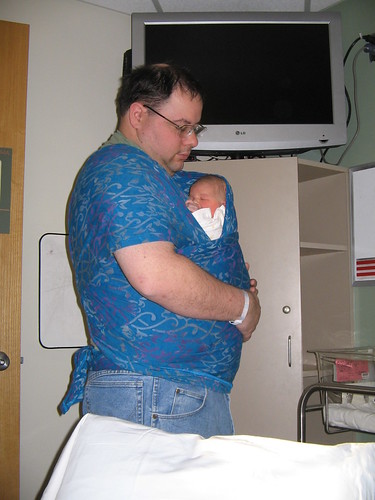

I generally prefer a two shouldered carrier for a newborn, as I tend to do a fair amount of traipsing around the playground after my older kids.  A great two shouldered option is a wrap or a simple piece of cloth.  Wraps come in stretchy and woven materials.  Wrap tutorials can be found in a variety of places online.  A fairly comprehensive chart can be found at The Babywearer.com.  These can have a steeper learning curve, but are very comfortable and adjustable for a variety of situations.  Also, as they are essentially a long piece of fabric, a stretchy wrap can be made very inexpensively (see previous article on Babywearing on a Budget).  Like slings, baby can be worn tummy to tummy or cradled.  The same rules regarding airway apply.  And wearing isn't just for mamas.  My husband broke out the wrap while we were still in the hospital so that he would be able to assist me with my first post-c-section shower.  The nurse was highly impressed.


Gretchen is demonstrating how to nurse in a wrap.  Hands free nursing isn't a beginner technique, but can be invaluable to getting out and about with baby.  My littlest one is 3 weeks and we've nursed in a carriers while wheel chairing out of the hospital, while on the playground with her siblings, at Christmas dinner, and most recently on a trip through Ikea.  The ability to nurse while continuing with other tasks is imperative to me as the mom of three, I'm actually doing it right now.  You can nurse in most any carrier depending on adjustability and anatomy.

 Notice that she gets baby settled with a good latch, baby is semi-upright.  You can nurse in upright, semi-upright, and cradle positions.  Once she has baby latched, she can then pull the loose outer rail across for privacy (as baby gets older this can also help minimize distractions). 

When nursing in a carrier, it is important to pay attention to baby and make sure that if baby falls asleep, she isn't smushed against mama.  Also make sure the fabric isn't pulled too tightly as to make it impossible for baby to pull away if necessary.  Pay attention to baby's breathing, just because it is hands free nursing, doesn't mean it is "set it and forget it."

Another more advanced wearing option is back carries.  I did my first back carry with this little one at 3 weeks.  I needed to prepare for company and she needed to be held, so back wrapping to the rescue.  This is not something to try on a whim and should be done with a woven wrap rather than a stretchy.  I have been wearing my almost 2yr old on my back since she was 2.5mo.  I got plenty of assistance at babywearing meetings and was confident in my abilities before attempting it with a newborn.  However, if you are experienced, or want to spend some time wearing dolls before giving it a shot with a spotter, this can be a great way to make your front available for needy toddlers.  I've used a ruck sack carry with a chest belt in this picture.

As with all carries, especially with newborns, it is important to pay attention to baby's breathing.  A high back carry can be helpful because baby will be breathing on your neck which makes it more obvious.
Finally we come to Asian style carriers like the mei tai, podaegi, and soft structure carrier.  This can be a happy medium between one shouldered carriers like the ring sling, and the more intimidating long length of fabric in a wrap.  These carriers are comfortable, can come in stylish prints, and tend to appeal to more men than ring slings or wraps.  For this reason I'm showing Angelique's husband and older daughter using mei tais with their babies.  Notice that for a newborn (or doll baby) the carrier is tied behind the baby's back.  Wearing instructions for Asian inspired carriers can be found here.
 
My husband is demonstrating a soft structured carrier (essentially a mei tai with buckles).  Soft structured carriers tend to be the least newborn friendly of the wearing options, but this particular one is designed to better accommodate small babies.  One reason soft structured carriers tend to not work as well for newborns is that they do not have the same level of adjustability and do not mold around a little body as closely as some other carriers.  However, they are very popular for older babies and toddlers, so if you plan to only own one carrier, you might want to consider them.  Once again, these are very popular with dads as they have buckles which are apparently manly (so guys tell me). 

Whatever carrier you choose, you will find yourself enjoying more cuddles and hearing less crying than without the carrier.  You won't find yourself pushing the stroller while trying to carry the baby in your arms, and your house will have less dishes and laundry waiting to be done as you try out your new-found free arms.

If you can't decide which carrier suits you best, come to a babywearing meeting and try things out.  Come while still pregnant and see the carriers in action, or arrive with your new bundle and try the carriers with your own newborn to discover what works best for your needs.  Some may find one carrier that will suit all of their needs; others may need 2 or 3; and still others may find they don't NEED more, but like shoes or purses, they want to have some options in carrier fashion.  No matter which category you find yourself in, I firmly believe that a good carrier is a parenting necessity.